


Prints
 No. 1
Under the Wave off Kanagawa (The Great Wave)神奈川沖浪裏
 No. 2
South Wind, Clear Sky凱風快晴
 No. 3
Thunderstorm Beneath the Summit山下白雨
 No. 4
Under Mannen Bridge at Fukagawa深川万年橋下
 No. 5
Fujimigahara in Owari Province尾州不二見原In stock
 No. 6
Senju in Musashi Province武州千住
 No. 7
Surugadai in Edo東都駿台
 No. 8
Cushion Pine at Aoyama青山円座松
 No. 9
Inume Pass in Kai Province甲州犬目峠
 No. 10
The Tamagawa River in Musashi Province武州玉川
 No. 11
Shichirigahama Beach in Sagami Province相州七里浜
 No. 12
Tsukuda Island in Musashi Province武陽佃島
 No. 13
Ushibori in Hitachi Province常州牛堀
 No. 14
Kajikazawa in Kai Province甲州石班澤
 No. 15
Lake Suwa in Shinano Province信州諏訪湖
 No. 16
Mishima Pass in Kai Province甲州三島越
 No. 17
In the Mountains of Totoumi Province遠江山中
 No. 18
Ejiri in Suruga Province駿州江尻
 No. 19
Honganji Temple at Asakusa in Edo東都浅艸本願寺
 No. 20
Umezawa Manor in Sagami Province相州梅澤左
 No. 21
Snowy Morning at Koishikawa礫川雪ノ旦
 No. 22
Shimomeguro下目黒
 No. 23
Yoshida on the Tokaido Road東海道吉田
 No. 24
Sea Lane off Kazusa Province上総ノ海路
 No. 25
The Coast of Nobuto登戸浦In stock
 No. 26
Nihonbashi Bridge in Edo江戸日本橋
 No. 27
Hodogaya on the Tokaido Road東海道程ヶ谷
 No. 28
Hakone Lake in Sagami Province相州箱根湖水
 No. 29
Sekiya Village on the Sumida River隅田川関屋の里
 No. 30
Reflection in the Surface of Lake Misaka in Kai Province甲州三坂水面
 No. 31
The Mitsui Shop at Surugacho in Edo江戸駿河町三井見世略図
 No. 32
Viewing the Sunset over Ryogoku Bridge from the Onmaya Embankment御厩川岸より両国橋夕陽見
 No. 33
Sazai Hall at the Temple of the Five Hundred Arhats五百らかん寺さゞゐどう
 No. 34
Waterwheel at Onden隠田の水車
 No. 35
Enoshima in Sagami Province相州江の嶌
 No. 36
Tago Bay near Ejiri on the Tokaido東海道江尻田子の浦略図
 No. 37
Tatekawa at Honjo本所立川
 No. 38
Mount Fuji seen in the Distance from Senju Pleasure Quarter従千住花街眺望ノ不二
 No. 39
Mount Fuji from Gotenyama at Shinagawa on the Tokaido Road東海道品川御殿山ノ不二
 No. 40
Nakahara in Sagami Province相州仲原
 No. 41
Mount Fuji from the Tea Plantation at Katakura in Suruga Province駿州片倉茶園ノ不二
 No. 42
Rice Paddies at Ono in Suruga Province駿州大野新田
 No. 43
Mount Fuji from Kanaya on the Tokaido Road東海道金谷ノ不二
 No. 44
Dawn at Isawa in Kai Province甲州伊沢暁
 No. 45
Back View of Mount Fuji from the Minobu River身延川裏不二
 No. 46
Groups of Mountain Climbers諸人登山
About this series
葛 飾 北 斎
KATSUSHIKA HOKUSAI
富嶽三十六景
THIRTY-SIX VIEWS OF MOUNT FUJI
Contents
- About Thirty-six Views of Mount Fuji
- When was it produced?
- What is Fugaku Sanjurokkei?
- Why Mount Fuji?
- The beauty of beroai blue fascinates the world
- Highlights of the series
About Thirty-six Views of Mount Fuji
Series
Thirty-six Views of Mount Fuji
(Fugaku Sanjurokkei)
Artist
Katsushika Hokusai
Total number of prints
All forty-six prints
Thirty-six Views of Mount Fuji (富嶽三十六景, Fugaku Sanjurokkei) is a series of woodblock prints illustrating the various landscapes of Mount Fuji, and it is among the most famous works of ukiyo-e artist Katsushika Hokusai (葛飾北斎: 1760-1849).
The series, as a whole, is also considered to be an iconic representation of the landscape ukiyo-e genre.
Many of you may recognize some of the pieces even if you aren’t familiar with their exact titles.
The famous print of the Great Wave is known to many people around the world, but it is just one of the 46 scenes in the series.

With these intriguing facts, it’s no wonder people around the world find Hokusai’s famous landscape series so inspiring. Of the series, the three prints Under the Wave off Kanagawa (神奈川沖浪裏, Kanagawa Oki Nami Ura), South Wind, Clear Sky (凱風快晴, Gaifu Kaisei), and Rainstorm Beneath the Summit (山下白雨, Sanka Hakuu) have acquired high acclaim both in Japan and abroad as works of exceptional artistic quality; these three are sometimes called the Sandai Yakumono (三大役物, the "three great highlights").

Under the Wave off Kanagawa (神奈川沖浪裏, Kanagawa Oki Nami Ura)
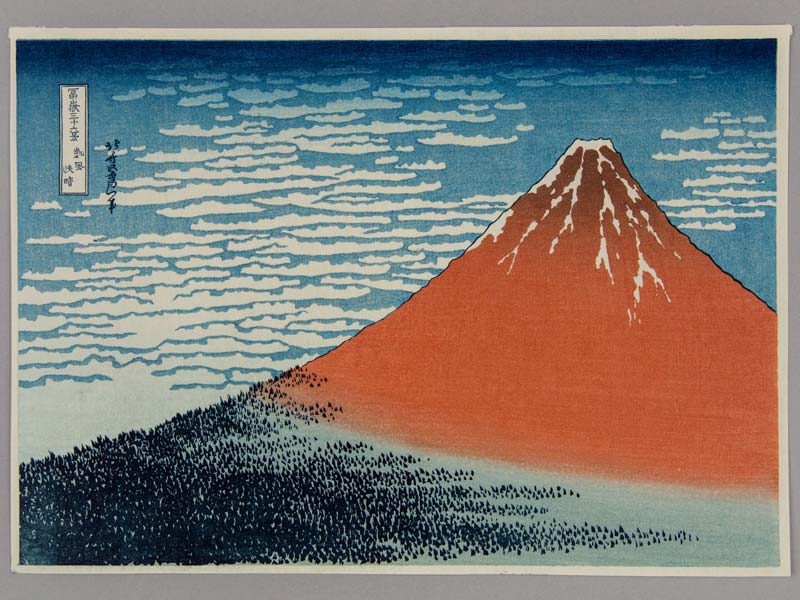
South Wind, Clear Sky (凱風快晴, Gaifu Kaisei)
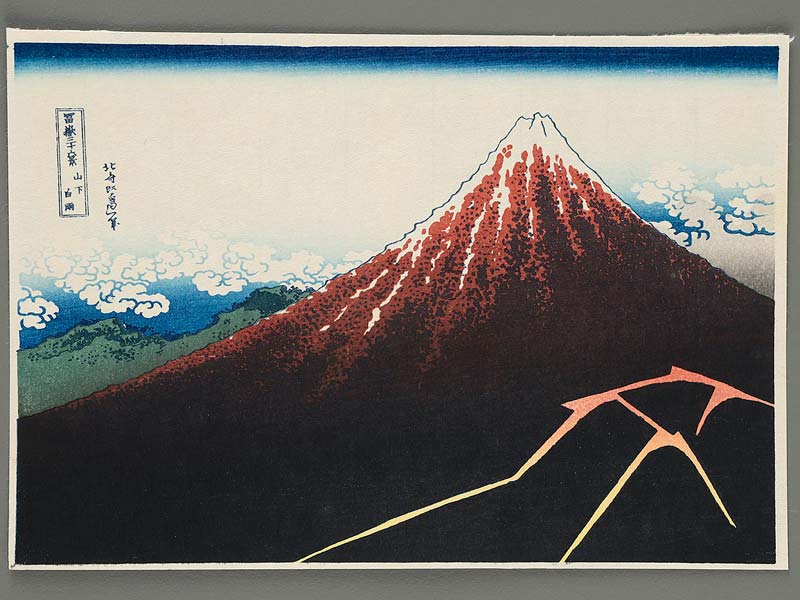
Rainstorm Beneath the Summit (山下白雨, Sanka Hakuu)
Highlights of the series

1. Beroai
Most of the works of the Mount Fuji series are painted using beroai, and of those prints, ten are aizuri-e, a type of ukiyo-e printed in varying shades of beroai blue.
Aizuri-e is a type of ukiyo-e printed only with different tints and shades of blue or with minimal use of an additional red and/or yellow.

2. Hokusai’s mastery of artistic expression
The woodblock prints capture the various facets of Mount Fuji as it shifts its appearance at every moment depending on the location, season, and weather condition. However, for some prints — most famously the Great Wave — even scholars cannot pinpoint the actual location, meaning that not all the sceneries depicted in the prints were true to life. Many of the works are said to be created through Hokusai’s elaborate imagination inspired by actual views and past works of landmark impressions. What gives this idyllic series its distinct character is that Hokusai depicted Mount Fuji with his remarkable composition skills and mastery of artistic expression. He intentionally altered the arrangement of the pictorial elements to capture the beauty and ferocity of nature.

3. Use of perspective
In the Edo period, ukiyo-e artists typically used tints and shades of colors to create depth; however, in this series of prints, Hokusai made bold and inventive use of European-style perspective — a technique already known in Japan through uki-e ("perspective pictures") since the 1740s.
Hokusai builds a sense of depth in almost every print of the Thirty-six Views of Mount Fuji, combining traditional Japanese composition with vanishing-point and Western-style perspective.
He artfully employed these and a variety of other techniques to highlight Mount Fuji, the primary subject matter, in its full glory.
Hokusai creatively experimented with and adopted daring compositions, eccentric ideas, and many other artistic innovations to keep people engaged in the Thirty-six Views of Mount Fuji. Fugaku Sanjurokkei is a treasure trove of masterpieces. Do enjoy all 46 idyllic impressions of Mount Fuji created by Hokusai.
New prints. New stories.
We email you when new woodblock prints arrive and when the Print Library adds a new story.